

Digital Ag Showcases Biofuels Innovation
Iowa State University’s Biocentury Research Farm and Digital Ag Innovation Lab teams joined forces to program a day of the annual Iowa Biofuels: Science and Sustainability Tour event on August 19.
The annual event is led by Iowa Biofuels and brings key congressional and administration staff to Iowa annually to learn about agriculture and biofuels from the farm field to the fuel pump.
It is a “see it, touch it, taste it and sometimes step in it” tour that gives attendees a hands-on look at how biofuels are becoming more efficient, lowering emissions, saving consumers money and boosting the rural economy.
Attendees first stopped at the Iowa State Sustainability Demonstration Farm managed by Digital Ag. Established in 2022, the Sustainability Demonstration Farm is a long-term, commercial-scale research site evaluating sustainable corn and soybean production systems.
Putting Sustainable Practices to the Test
The delegation learned how emerging agriculture technologies and management practices are shaping the future of sustainable crop production and renewable fuels. Digital Ag staff led the group through the farm's research plots, discussing how field-scale research can help connect agricultural production with the needs of the biofuels industry. 
The farm includes fields managed under different crop production management systems which include different tillage systems like conventional tillage, vertical tillage, strip-tillage and no-tillage. Researchers also evaluate practices such as cover crops, crop rotation and nitrogen use efficiency.
The Digital Ag team emphasized the importance of testing practices at a scale that reflects real-world farming.
"If research isn't done at production scale; it's very hard to translate that into practices for growers that are trying to implement these practices," Ryan Huffman, senior research manager for agronomy and outreach at Digital Ag, said.
The research provides farmers and industry partners with an opportunity to see how different practices perform over time and consider how the findings could apply to their own operations.
Connecting the Farm to Biofuels
For the renewable fuels industry, the research has implications beyond the field. Practices such as reduced tillage, cover crops, and more efficient nitrogen applications can contribute to soil health and nutrient efficiency while supporting the production of lower-carbon corn and soybean feedstocks.
The tour also highlighted the broader connections between agricultural production and bio-based products. Agricultural residues, for example, can be used beyond traditional crop production. The research being conducted is exploring how residues can be processed into products such as time-release nitrogen fertilizers.
"There is an ecosystem that we're working with within the university, at Iowa State across multiple research teams," Rob Hartmann, assistant director for research administration at BCRF, said. "There's a lot of collaboration that takes place."
Technology Bringing Precision to the Field
The group also learned how precision agriculture technologies are helping farmers make more targeted decisions. GPS guidance allows equipment to return to a precise location in a field, while drones and cameras provide new ways to monitor crop conditions.
Targeted spraying technology was one example discussed during the tour. Cameras and computer vision can identify weeds in real time, allowing sprayers to apply herbicide only where it is needed. The Digital Ag staff shared that research has demonstrated potential reduction in herbicide use while maintaining effective weed control.
Artificial intelligence is also creating new possibilities for analyzing field imaging and identifying crop stresses. As these technologies advance, researchers see opportunities to identify problems earlier and help farmers make more precise decisions about when and where to apply inputs.
From the Farm to Digital Ag
Following the farm tour, the group returned to the Alliant Energy Ag Innovation Lab for an afternoon focused on the broader bioeconomy and agricultural innovation ecosystem.
During a lunch-and-learn session, Dr. Lisa Schulte Moore discussed public-private collaboration, the development of new value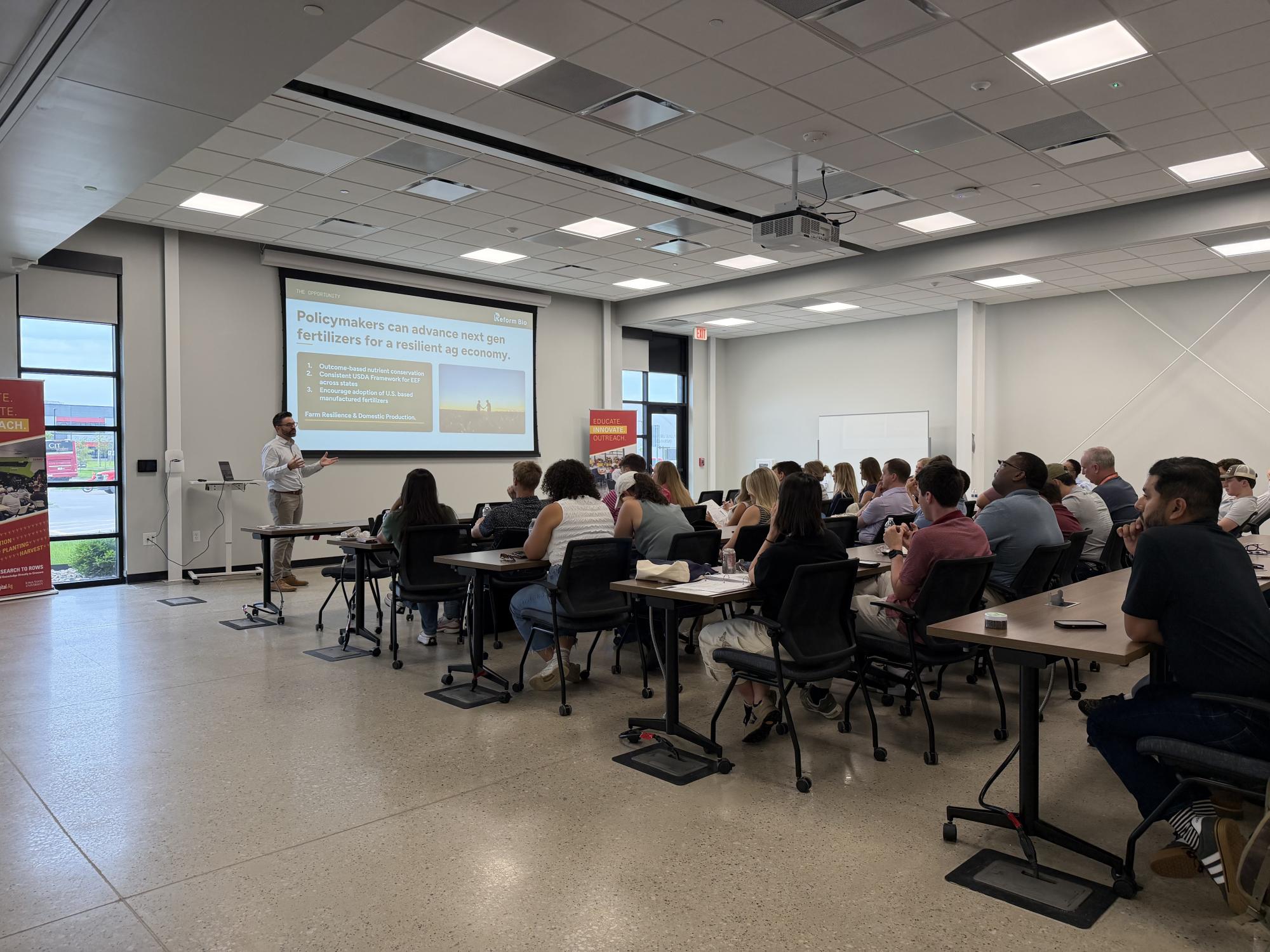 chains, research and demonstration of processing systems and conversion technologies and the work needed to scale technologies toward a combination of biobased products and associated services.
The day concluded with an Ag Innovators Startup Roundtable featuring Reform Bio and Landwright. Reform Bio, led by co-founder and CEO Kyle Luther Anderson, is developing biochar-based, slow-release nitrogen fertilizers designed to improve nutrient efficiency and protect water quality. Landwright, represented by Mark Vande Haar, develops smart robotics to identify and remove invasive species in hardwood forests. Both startups highlighted how emerging technologies can turn research into practical solutions for agriculture and environmental conservation.
Following the afternoon sessions, the group traveled to AgCertain for a tour and brief presentation.
Together, the sessions demonstrated the connections between research, technology, agriculture and renewable fuels and the importance of collaboration in moving innovative ideas from the research stage toward real-world applications.
Contact
Alison Doyle, ISU Digital Ag Innovation Lab, (515)-509-3361, adoyle@iastate.edu